



AI Meets Your Applications (What is MCP and Why Your Business Needs It Now)

Imagine this: You are managing a complex resource scheduling system. Instead of clicking through multiple screens, filling out forms, and remembering which fields are required, you simply tell an AI assistant: "Schedule a 2-hour virtual session for next Tuesday afternoon with two providers." The AI understands your request, asks clarifying questions if needed, and completes the entire process all through natural conversation. This is not science fiction. This is the power of the Model Context Protocol (MCP).
Traditional application programming interfaces (APIs) have served us well, but they require technical knowledge. Developers need to understand endpoints, request formats, authentication tokens, and response structures. For business users and product owners, this creates a barrier to accessing the full potential of their applications.
Enter MCP a revolutionary protocol that acts as a bridge between Large Language Models (LLMs) and your applications. It enables AI assistants to interact with your software as naturally as humans do, opening up possibilities that were previously unimaginable.
What is MCP?
Think of MCP as a universal translator between AI and your applications. Just as a human interpreter helps two people who speak different languages communicate, MCP helps AI understand what your application can do and how to use it.
MCP in Simple Terms: MCP (Model Context Protocol) is a standardized way for AI systems to discover, understand, and interact with your applications capabilities. It is like giving your AI assistant a menu of what your application can do, along with clear instructions on how to order from it.
Why Traditional Approaches Fall Short
Traditional APIs present several challenges when it comes to AI integration:
• Technical Complexity: APIs require understanding of HTTP methods, JSON structures, authentication mechanisms, and error codes. This technical knowledge barrier prevents non-technical users from leveraging AI assistance.
• Rigid Structure: APIs are designed for machines, not conversations. They do not handle ambiguity, context, or follow-up questions well.
• No Intelligence: Traditional APIs are "dumb" they do exactly what you tell them, nothing more. They cannot suggest alternatives, catch mistakes, or guide users through complex workflows.
• Fragmented Experience: Each API is different, requiring custom integration code for every application you want to connect to AI.
How MCP Solves These Problems
| Benefit | What It Means |
|---|---|
| Standardized Protocol | MCP provides a universal language that any LLM can understand, eliminating the need for custom integration code for each application. |
| Natural Language Interface | Users interact with your application through conversation, making it accessible to everyone regardless of technical expertise. |
| Intelligent Assistance | AI can understand context, ask clarifying questions, suggest alternatives, and guide users through complex processes. |
| No Code Changes | MCP wraps around your existing application you do not need to modify your core codebase to enable AI integration. |
MCP is required because it's the missing piece that makes AI truly useful for business applications. Without it, AI assistants are limited to general knowledge and can't interact with your specific business systems. With MCP, your AI becomes a knowledgeable assistant that understands your business processes and can help users accomplish real work.
The MCP Architecture
The beauty of MCP lies in its simplicity: you don’t need to rebuild your application; instead, you create an MCP server that wraps your existing system and exposes its capabilities in a way AI can easily understand and use.
How it works in practice:
| Steps | What Happens |
|---|---|
| 1 | User makes a request: "Schedule a resource for next Tuesday at 2 PM" |
| 2 | LLM processes the request and identifies which MCP tool to use |
| 3 | MCP Server receives the call and translates it into your applications API calls |
| 4 | Your application processes the request using existing business logic |
| 5 | Response flows back through MCP and is translated to natural language for the user |
Creating MCP Tools
MCP tools are the building blocks that expose your applications capabilities. Each tool representing a specific action your application can perform. For example, in a resource scheduling system, you might create tools like:
• ListAvailableResources - Shows what resources are available
• ScheduleResource - Creates a new scheduling entry
• CheckAvailability - Verifies if a time slot is free
• GetResourceDetails - Retrieves information about a specific resource
The key insight: Each tool has a clear name, description, and schema that tells the AI when to use it and what parameters it needs. The LLM can read this schema and intelligently guide users through processes, asking for required information and handling optional parameters appropriately.
What's Next
We have established what MCP is and why it is transformative. But how does this play out in real-world business scenarios? In Episode 2, we'll explore one of the most powerful applications: Analytics and Reporting Without Developers, showing how MCP enables self-service data insights that previously required technical teams and weeks of development time.
AWS Migration Checklist: A Practical Roadmap for Modern Businesses
Migrating businesses to AWS offers many benefits, including cost optimization, improved security, and greater scalability. However, a successful migration requires careful planning and execution. Otherwise, organizations may experience...
Read More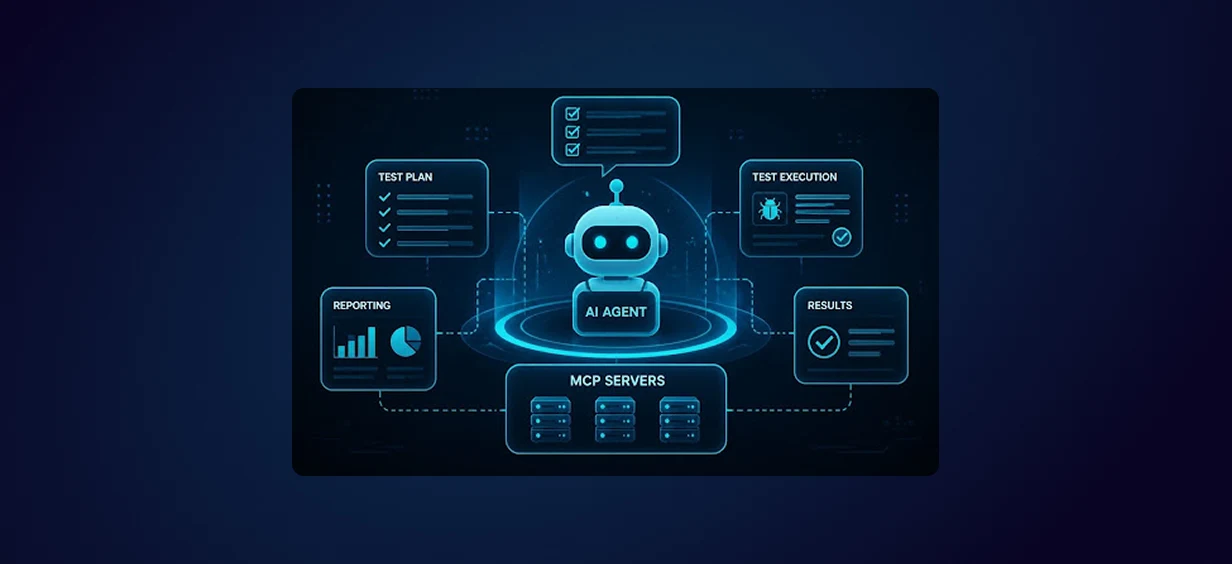
Agentic AI for QA & Software Testing with MCP Servers
For years, QA engineers have relied heavily on manual testing, repetitive validation, documentation, and traditional automation scripts But now, a new era of testing...
Read More
Our Proven Web Development Process That Delivers Real Results
In software development, success does not come from coding alone. Real results come from understanding business needs, planning the right workflow, building user-friendly designs...
Read More
Secure AWS Connectivity Using AWS Systems Manager (SSM)
In traditional cloud architectures, secure access to private resources such as databases and internal servers often relies on...
Read More
Building a Secure Multi-Account AWS Architecture for Enterprise Environments (Dev, STG, UAT, Prod)
In today’s cloud-first world, scalability and speed are no longer enough security, governance, and cost control are equally critical...
Read More
Why You Should Use AI Agents Over Single Prompts: Unlocking the Power of Adaptive AI for Complex Workflows
In the world of artificial intelligence (AI), one of the biggest advancements has been the rise of AI agents that adapt dynamically to real-time data and complex workflows...
Read More
Production Ready ( Quality, performance, and the lessons learned shipping to 150 stores )
We chose dbt over custom scripts, built observability, optimized performance, and shipped to production...
Read More
Scaling from 15 to 150 Stores ( When copy-paste becomes technical debt, macros become salvation )
We built a pipeline with observability, incremental models for performance, and snapshots for history. Our 15-store deployment ran smoothly...
Read More
Keeping Your Data Fresh: ( The wake-up call at 3am that taught us about observability )
That morning taught us a crucial lesson: a successful dbt run doesn't mean your data is fresh, accurate, or complete. You need observability.
Read More