


Using EventBridge for Async Communication in a Serverless Microservice Architecture

Introduction
Microservices often begin with simple, synchronous communication: Service A calls Service B’s API and waits for a response. This is easy to understand, but as systems grow it creates predictable pain:
- Tight coupling: A change or outage in one service impacts others.
- Failure propagation: Timeouts and partial outages spread across the request chain.
- Latency and scaling issues: Each hop adds latency, and traffic spikes can overload dependencies.
Asynchronous, event-driven architecture reduces these problems by shifting from “call and wait” to “publish and react.” Instead of directly invoking downstream services, a service publishes an event such as OrderCreated. Other services process that event independently, when they are ready.
In serverless systems, this model fits naturally. Services like AWS Lambda and Step Functions are already event-oriented. Amazon EventBridge provides a managed event routing layer that connects producers and consumers without building custom fan-out logic or relying on polling.
What Is Asynchronous Communication?
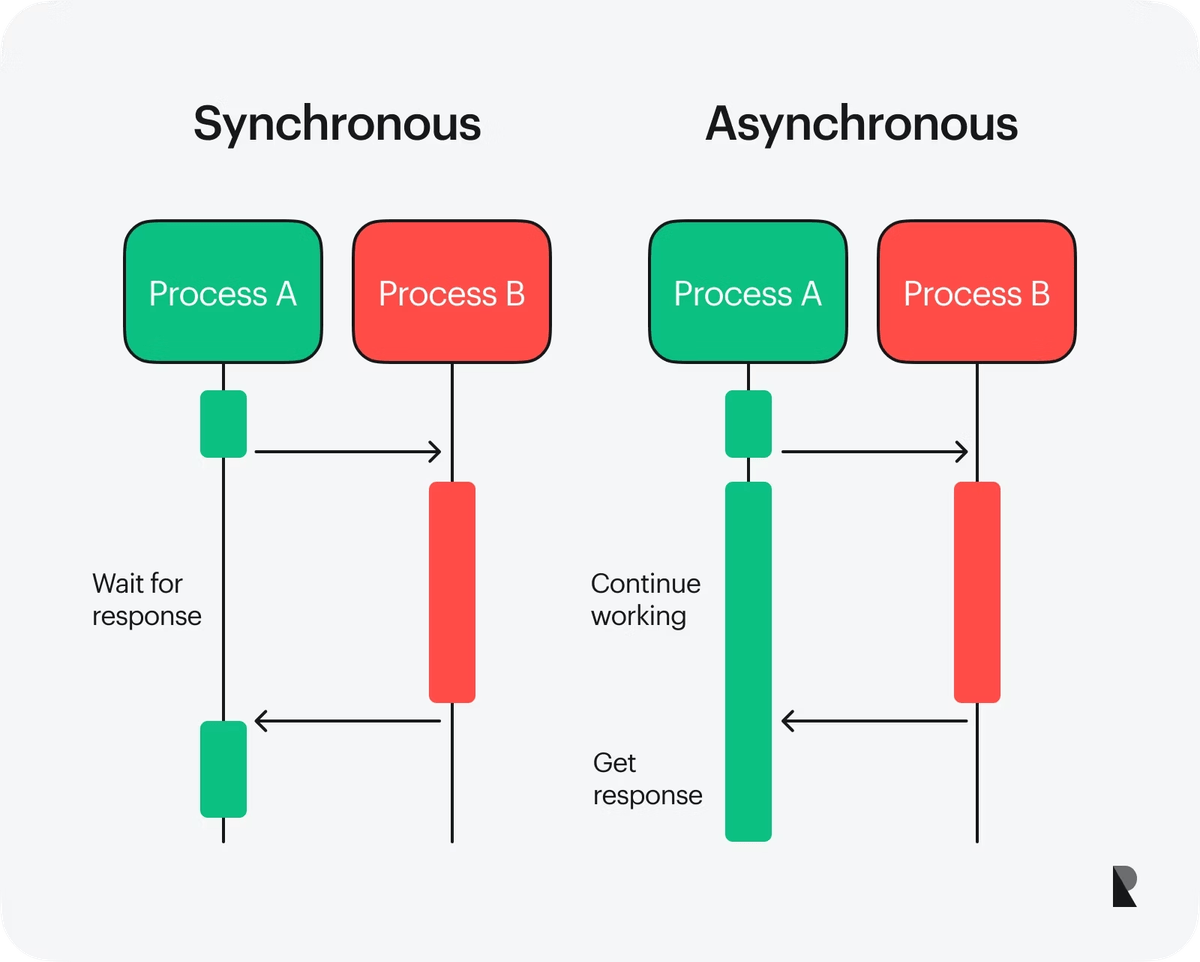
Asynchronous communication in microservices means a service sends a message (an event) and continues its work without waiting for other services to finish.
Synchronous vs asynchronous communication
Synchronous (request/response)
- Pattern: Service A calls Service B and blocks until B responds.
- Best for: User-facing reads, immediate validation, simple query flows.
- Common risks: Cascading failures, long-tail latency, coupled deployments.
Asynchronous (event-driven)
- Pattern: Service A publishes an event; consumers process it later.
- Best for: Background processing, multi-service reactions, workflows that tolerate eventual consistency.
- Key tradeoff: Results may not be immediate, so you design for “accepted now, completed shortly.”
When async is the better choice
Asynchronous communication is usually a better choice when:
- Multiple services must react to the same business change (billing, inventory, notifications, analytics).
- You want services to scale independently without amplifying load across a call chain.
- You can accept eventual consistency (for example, payment and shipment happen after order creation).
- You want stronger fault isolation so one consumer’s outage does not block the producer.
Why Amazon EventBridge?
What EventBridge is and how it works
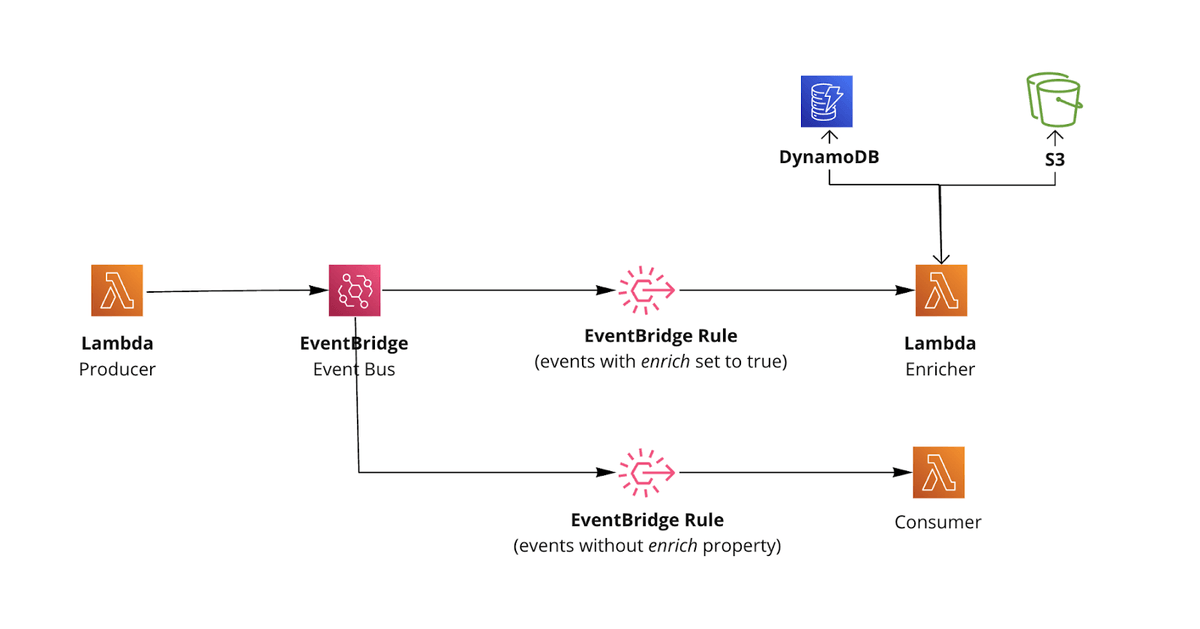
Amazon EventBridge is a managed event bus service. Producers send events to an event bus, and EventBridge routes those events to targets based on matching rules.
At a high level:
- Producers publish events to an event bus
- EventBridge evaluates rules to match events by attributes and payload fields
- Matching events are delivered to one or more targets (consumers)
Why EventBridge fits serverless architectures better than direct API calls or polling
- Decouples services cleanly: Producers do not need to know who consumes events or how many consumers exist.
- Reduces synchronous dependency chains: Failures and latency in consumers do not automatically block the producer’s request path.
- Avoids polling: Consumers can react when events occur rather than repeatedly checking for changes.
- Enables selective fan-out: One event can trigger multiple consumers, but only those that match the routing rules.
Architecture Overview
Core roles in an EventBridge-based design
Producers
Services that publish events when meaningful business changes occur (for example, Orders publishes OrderCreated).
Event bus
The routing layer that receives events and applies rules.
Rules
Filters that decide which events should be delivered to which consumers.
Consumers (targets)
Services that react to events (for example, Inventory, Billing, Notifications, Analytics).
Benefits of using EventBridge
EventBridge helps you keep services independent. Producers publish events without knowing who will consume them, so you can add or change consumers without changing the producer. Each consumer can scale on its own, and if one consumer fails, it usually does not break the producer or other consumers. It also makes it easier to add new features by subscribing to existing events, and reduces operational effort because AWS handles most of the routing and scaling
Challenges and Best Practices
Event versioning
Treat events like a long-term contract because multiple services may depend on them for years. Avoid breaking changes by adding new fields instead of renaming or removing existing ones. Include an eventVersion and keep a simple record of what changed in each version so consumers can upgrade safely.
Error handling and retries
Assume consumers will fail sometimes due to timeouts, outages, or throttling. Use controlled retries for temporary failures, but avoid infinite retry loops. Have a clear failure path (for example, a dead-letter queue or quarantine process) so repeatedly failing events can be inspected and fixed without blocking everything else.
Idempotency
Duplicate delivery can happen in event-driven systems, so consumers must be safe to run more than once. Use an idempotency key (often the event id, or something like orderId + eventType) and track what has already been processed. Design side effects like charging, reserving stock, and sending notifications so they cannot accidentally happen twice.
Monitoring and observability
Log with enough context to trace a business flow, such as correlation id, order id, event type, and processing outcome. Measure consumer health using success/failure rates, latency, and retry counts (and backlog indicators when applicable). Use the correlation id to follow one transaction across services and quickly find where issues happen.
Security considerations
Apply least-privilege permissions so producers can only publish to the intended event bus, and consumers can only access what they need. Isolate environments (dev/test/prod) so events do not leak across systems. Validate event payloads in consumers and handle malformed events safely.
Conclusion
Synchronous microservice calls can quickly create tight coupling, cascading failures, and latency chains. Asynchronous, event-driven communication reduces these issues by letting services publish business events and letting other services react independently.
Amazon EventBridge provides a practical, serverless-friendly way to route events to multiple consumers with rule-based filtering and a managed operational model. With disciplined event contracts, idempotent consumers, and solid observability, EventBridge can become a reliable backbone for asynchronous communication in a serverless microservices architecture.
Practical takeaway: Start with a small set of high-value business events (like OrderCreated). Define them as stable contracts (versioned, traceable), route them through EventBridge rules, and build consumers that are idempotent and observable. This foundation scales more safely than growing chains of service-to-service API calls

AWS Migration Checklist: A Practical Roadmap for Modern Businesses
Migrating businesses to AWS offers many benefits, including cost optimization, improved security, and greater scalability. However, a successful migration requires careful planning and execution. Otherwise, organizations may experience...
Read More
Agentic AI for QA & Software Testing with MCP Servers
For years, QA engineers have relied heavily on manual testing, repetitive validation, documentation, and traditional automation scripts But now, a new era of testing...
Read More
Our Proven Web Development Process That Delivers Real Results
In software development, success does not come from coding alone. Real results come from understanding business needs, planning the right workflow, building user-friendly designs...
Read More
Secure AWS Connectivity Using AWS Systems Manager (SSM)
In traditional cloud architectures, secure access to private resources such as databases and internal servers often relies on...
Read More
Building a Secure Multi-Account AWS Architecture for Enterprise Environments (Dev, STG, UAT, Prod)
In today’s cloud-first world, scalability and speed are no longer enough security, governance, and cost control are equally critical...
Read More
Why You Should Use AI Agents Over Single Prompts: Unlocking the Power of Adaptive AI for Complex Workflows
In the world of artificial intelligence (AI), one of the biggest advancements has been the rise of AI agents that adapt dynamically to real-time data and complex workflows...
Read More
Production Ready ( Quality, performance, and the lessons learned shipping to 150 stores )
We chose dbt over custom scripts, built observability, optimized performance, and shipped to production...
Read More
Scaling from 15 to 150 Stores ( When copy-paste becomes technical debt, macros become salvation )
We built a pipeline with observability, incremental models for performance, and snapshots for history. Our 15-store deployment ran smoothly...
Read More
Keeping Your Data Fresh: ( The wake-up call at 3am that taught us about observability )
That morning taught us a crucial lesson: a successful dbt run doesn't mean your data is fresh, accurate, or complete. You need observability.
Read More