
Retail Data Chaos: How We Found Our Way Out ( When spreadsheets fail and databases multiply, where do you turn? )

Got a project?
Let's discuss your project
The Problem: Drowning in Retail Data
Picture this: You're managing data for a growing retail chain. Store after store opens New York, San Francisco, Los Angeles each with its own MySQL database. Each database has the same schema: orders, customers, products, order_items. Simple enough, right?
Wrong.
Fast forward six months. Your CEO wants a single dashboard showing daily sales across all stores. Your marketing team needs customer analytics that span regions. Your finance team is manually combining spreadsheets from fifteen different databases every quarter.
The Daily Struggles
- Custom Python scripts break every time a store schema drifts
- SQL queries embedded in code strings are impossible to review or test
- No one knows which transformation ran last or if it succeeded
- Data quality issues surface only when executives spot them in reports
- Adding a new store means copying and modifying dozens of scripts
Sound familiar? This was us. We tried band-aids: more Python scripts, scheduled jobs that emailed error logs no one read, shared Google Sheets that became "sources of truth" through sheer desperation.
The Search for Something Better
We knew we needed a real solution. Not another hack, but a framework that could grow with us. We looked at the usual suspects:
Airflow and Prefect were tempting for orchestration. But they're just schedulers they didn't solve our core problem of managing SQL transformations, testing data quality, or documenting our data models.
Traditional ETL tools like SSIS and Informatica felt heavy. GUI-driven workflows, license fees, and the inability to version control our logic in Git made them feel like the wrong era's solution.
Custom Python ETL was what we already had and it was the problem, not the solution. SQL buried in string templates, no easy way to understand dependencies, and tribal knowledge locked in individual developers' heads.
Then someone mentioned dbt.
What Is dbt, Really?
Here'sthe pitch that won us over: dbt (data build tool) treats SQL transformations as code. You write SELECT statements normal SQL and dbt handles everything else:
Dependencies - Reference models with ref(), and dbt automatically figures out what to run first
Materialization - Choose whether each model becomes a view or table without writing DDL
Testing - Define data quality checks right alongside your models
Documentation - Auto-generated docs with lineage graphs showing how everything connects
But here's what sealed the deal for our retail scenario: dbt is SQL-first. Our team already knew SQL inside and out. We didn't need to learn a new language or paradigm. We just needed better tools for what we were already doing.
Why dbt Won for Multi-Tenant Retail
Our situation had a specific challenge: many source databases(one per retail store) feeding into one centralized analytics warehouse. Each store had the same schema structure, but we needed to process them dynamically
dbt's variable system made this possible. Instead of hardcoding schema names, we could parameterize them:
Let's Build Something Great Together
Ready to transform your idea into a powerful software solution? Talk to our experts and get a free consultation.
Contact Us
The Magic: We write our models once using variables like var('source_schema') and var('target_schema'). At runtime, we pass in which store to process: dbt run --vars "{source_schema: retail_store_ny, target_schema: analytics_retail}"
This meant one dbt project could handle all our stores. No copy-paste. No drift. Just clean, reusable SQL.
The Architecture That Saved Us
We adopted a three-layer structure that became our north star:
Staging Layer
One model persource table. Clean up column names, cast data types, but stay close to the source. Think of it as your data's first impression in the warehouse you want it presentable but still recognizable.
Intermediate Layer
This is where business logic lives. Join orders with customers. Enrich order items with product details. Calculate derived metrics. These models are the work horses that transform raw data into meaningful insights.
Marts Layer
The final products: clean, aggregated, analytics-ready tables. mart_daily_store_sales becomes the single source of truth for revenue reporting. mart_customer_lifetime_value powers marketing campaigns.
This structure did something magical: it made our data pipeline understandable. A new team member could look at the project structure and immediately grasp the flow from raw data to business insights.
The First Win
We started with a pilot: the orders table from our New York store. Three models: stg_orders, int_orders_enriched , and mart_daily_store_sales. With tests to ensure order IDs were unique and revenue calculations were correct.
The first successful dbt run felt like magic. Green checkmarks cascading down the terminal. Tests passing. Documentation generating automatically. Data flowing from retail_store_ny into analytics_retail with complete lineage tracked.
Then we ran it again for San Francisco. Same code, different source_schema variable. Worked perfectly.
That's when we knew we'd found our answer.
Coming Up Next
We've chosen our tool and built our foundation. But a retail data warehouse isn't complete until we solve three critical challenges: keeping data fresh, handling explosive table growth, and preserving history. In Episode 2, we'll tackle observability, incremental processing, and snapshots.
We've chosen our tool and built our foundation. But a retail data warehouse isn't complete until we solve three critical challenges: keeping data fresh, handling explosive table growth, and preserving history. In Episode 2, we'll tackle observability, incremental processing, and snapshots.
The dbt Migration Chronicles · Episode 1 of 4
Written for data teams navigating the journey from chaos to clarity

AI Writes the Code • Stop Blindly Shipping It Without Reviewing the Engineering
A practical perspective on AI-generated code, scalability, maintainability, and engineering judgment and why engineering review still owns the final decision.
Read More
Migrating Databases with AWS DMS With Nearly Zero Downtime
Learn how to migrate databases using AWS DMS with nearly zero downtime using Full Load, CDC, validation, monitoring, and controlled cutover.
Read More
How to Add LiveKit Video Calling to a Next.js App
Add embedded video & audio calling to Next.js with LiveKit Cloud. Compared vs Twilio, Daily, Agora, Zoom — plus token auth, guests & recording.
Read More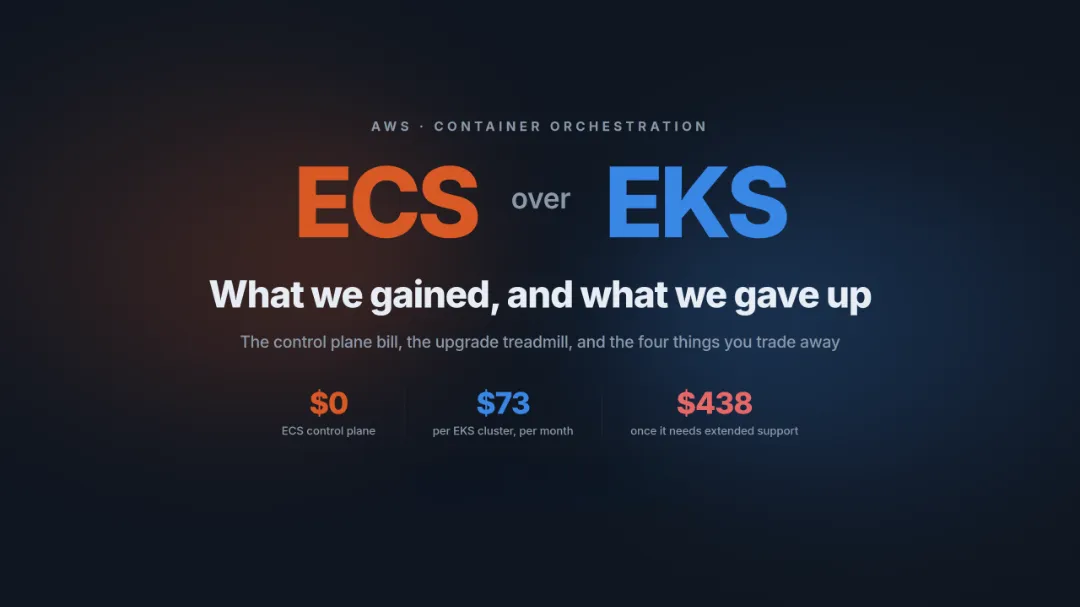
We chose ECS over EKS: what we gained and what we gave up
An honest comparison of ECS vs EKS the costs, tradeoffs, and real-world reasoning behind choosing ECS for a production platform on AWS.
Read More
Upgrading Legacy Systems: From Outdated Technology to Competitive Advantage
Learn how to upgrade legacy systems through application modernization, API integration, cloud migration, security improvements, and incremental system upgrades without disrupting business operations.
Read More
Building Distributed Tracing and Observability with AWS X-Ray
A practical guide to correlating requests across a multi-tier application using correlation IDs, AWS X-Ray segments, and structured logging for faster incident debugging.
Read More
Designing Before and After AI: What Really Changed
A look at how AI has transformed UI/UX design from manual wireframes and slow research to AI-assisted prototyping, design-to-code, and personalization at scale.
Read More
Beyond Prompting: Managing Context and Tokens in AI Coding Tools
Ever wondered why your AI coding agent starts losing context or hits a hard limit mid-task? The answer lies in tokens and the context window. Good AI coding is not about giving the model the most information. It is about giving it the right information at the right time.
Read More
What Is llms.txt? How It Helps Google, AI Search, and Agentic Browsing Find Your Website
Learn what llms.txt is, how it differs from sitemap.xml and robots.txt, and how it can help your site get found by Google, AI search tools, and AI agents.
Read More