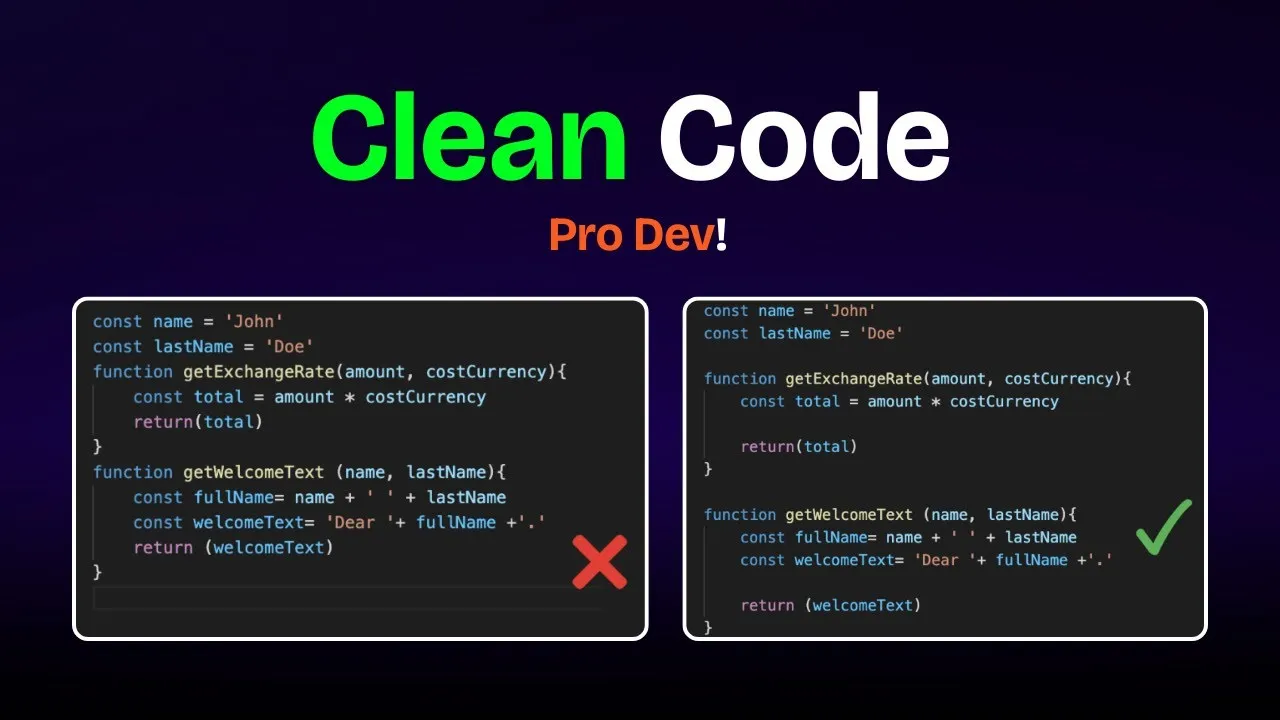
Clean Code vs. Overengineering: Where Should Developers Draw the Line?

Got a project?
Let's discuss your project
Clean code reduces unnecessary complexity. Overengineering creates complexity in anticipation of problems that may never exist. The line between them is drawn by context, evidence, and the cost of change.
There is a strange paradox in software development.
We are constantly told to write clean code. Keep functions small. Follow SOLID principles. Avoid duplication. Use abstractions. Separate responsibilities. Design for change.
All of that sounds reasonable.
But taken too far, the same principles can produce code that is harder to understand than the problem it was supposed to solve. A simple feature can turn into an interface, an abstract class, a factory, a strategy, a dependency-injection configuration, and three layers of services all because someone thought, “We might need this someday.”
At that point, we have crossed an important line.
The goal of good software engineering isn’t to make code as sophisticated as possible. It is to make software easy enough to understand, change, test, and operate for the problem it actually has to solve whether that is a small internal tool or a large-scale custom software development effort.
So where exactly is the line between clean code and overengineering? The answer isn’t a specific number of classes, a particular design pattern, or a checklist of principles. It is context, evidence, and trade-offs.
What Does “Clean Code” Actually Mean?
Clean code is often misunderstood as code that follows a long list of rules: small functions, meaningful names, no duplication, lots of abstractions, strict adherence to design principles.
But clean code is not about satisfying rules for their own sake. At its core, clean code is code that communicates its intent clearly and can be changed without unnecessary friction. Modern discussions of clean-code practices similarly emphasize readability, understandability, and maintainability rather than complexity for its own sake.
Consider two examples.
1def calculate_total(items):2 return sum(item.price for item in items)
And:
def calculate_total(items):calculator = TotalCalculationService(strategy=DefaultPricingStrategy(provider=PricingProviderFactory.create()))return calculator.calculate(CalculationContext(items=items))
The second example might be justified in a genuinely complex pricing system. But if all we need to do is add the prices of a list of items, the first solution is probably cleaner.
Why? Because simplicity is part of cleanliness. A developer reading the first example immediately understands what is happening. The second requires the reader to navigate through multiple abstractions before discovering that the application is simply adding numbers.
Clean code should reduce cognitive load, not increase it.
The Problem With “Best Practices”
One of the easiest traps for developers especially experienced developers is treating software principles as universal laws:
- “Never repeat yourself.”
- “Always use interfaces.”
- “Every class should have one responsibility.”
- “Always make your code extensible.”
- “Don’t use large functions.”
These principles can be useful. But a principle without context can become dogma.
Take DRY: Don’t Repeat Yourself. Suppose you have two pieces of code that currently look almost identical. You could immediately extract them into a shared abstraction. But what if they represent two different business concepts that are likely to evolve independently? You’ve removed duplication in the code while introducing coupling between two unrelated concepts. Now a change to one feature can unexpectedly affect another.
In other words, not all duplication is bad, and not all abstraction is good. The same applies to SOLID, design patterns, dependency injection, microservices, event-driven architecture, and almost every other technique in our toolbox.
The question shouldn’t be:
"Can I apply this principle?"
It should be:
"Does applying this principle solve a real problem here?"
That single question can prevent a lot of unnecessary complexity.
When Clean Code Becomes Overengineering
Overengineering usually starts with good intentions. A developer thinks: “Let’s make this flexible.” Then: “Let’s make it reusable.” Then: “Let’s make it extensible.” Then: “Let’s make sure we can swap implementations later.” And suddenly a 30-line feature has become a miniature framework.
The problem isn’t that any individual decision is necessarily wrong. The problem is that the accumulated complexity has no corresponding value.
Imagine you’re building an application that sends password-reset emails. You currently have one email provider. A straightforward implementation might be:
email_service.send_reset_email(user)
But you decide that one day you might support another provider. So you create:
EmailProvider├── SendGridProvider└── SMTPProvider
Then you add EmailProviderFactory, EmailProviderConfiguration, EmailProviderResolver, and EmailProviderStrategy.
You have successfully designed a system that can support multiple providers. There is just one problem: you only have one provider. You haven’t solved a current problem. You’ve created a future maintenance obligation.
This is where YAGNI “You Aren’t Gonna Need It” becomes useful. The principle encourages developers to defer speculative functionality until there is evidence that it is actually needed.
That doesn’t mean developers should never think about the future. It means we should be careful about building the future before we know what it looks like.
The Cost of Abstraction
Abstraction is powerful. It allows us to hide implementation details, isolate responsibilities, and create boundaries between components. But abstraction isn’t free. Every abstraction introduces something that a developer has to understand.
Consider this:
user = repository.find_by_id(user_id)
Now compare it with:
user = (UserQueryContextFactory.create().with_repository(UserRepositoryAdapter()).with_strategy(DefaultUserRetrievalStrategy()).execute(user_id))
The second approach may be useful in a sophisticated system with real variation in retrieval strategies. But if there isn’t such variation, you’ve increased the number of concepts a developer needs to understand without increasing the value delivered by the system.
This is one of the most important lessons about clean architecture: every abstraction should earn its place.An abstraction is valuable when it reduces complexity somewhere else. If it merely moves complexity around or creates more of it it may not be helping.
The Three-Implementation Rule
One useful heuristic is to avoid creating abstractions too early.
Suppose you write the same logic twice. You might immediately think: “I should extract this into a reusable component.” Sometimes you should. But sometimes the two pieces of code only look similar their requirements may diverge later.
A practical approach is:
- 1First occurrence write the straightforward solution.
- 2Second occurrence pay attention to the emerging pattern.
- 3Third occurrence consider whether the pattern is stable enough to abstract.
This isn’t a law of software development. There are plenty of cases where abstraction makes sense immediately for example, when a boundary is required by an external system or when multiple implementations already exist. But as a general heuristic, it helps avoid premature generalization.
You aren’t trying to eliminate every repeated line. You’re trying to identify repeated knowledge and stable concepts.
Don’t Confuse “Simple” With “Poorly Designed”
There is an important counterargument here.
If developers hear “avoid overengineering,” they may interpret it as: “Just write the simplest code possible.” That can be just as dangerous.
Simple code isn’t necessarily good code. Consider a 500-line function containing business logic, database operations, validation, logging, and API responses. Technically, it may be “simple” because there are no abstractions. But it is difficult to test, difficult to modify, and difficult to reason about. That’s not clean code.
The goal isn’t minimum code. The goal is minimum unnecessary complexity. Those are very different things.
Let's Build Something Great Together
Ready to transform your idea into a powerful software solution? Talk to our experts and get a free consultation.
Contact Us
Sometimes good design requires more structure. If a system has several genuine business domains, clear boundaries may be necessary. If multiple implementations already exist, an interface may be valuable. If a component needs to be independently tested or replaced, dependency inversion can make sense. If a system has millions of users and strict availability requirements, architectural complexity may be justified.
The key word is justified.
The Context Changes Everything
Imagine two teams building two different products.
Team A is building an internal dashboard used by 20 employees. The application has a small database, a handful of endpoints, and one deployment environment. A modular monolith might be more than enough.
Team B is building a global payment platform. They have strict availability requirements, regulatory constraints, multiple teams, millions of transactions, and several independent systems. The architecture will naturally be more complex.
It would be absurd to tell Team B: “Just keep it simple. Don’t overengineer.”
Complexity isn’t automatically overengineering. Unnecessary complexity is. A distributed system isn’t overengineered simply because it has many services. A monolith isn’t automatically clean simply because it has fewer components. Architecture should reflect the problem.
A Better Question: What Is the Cost of Being Wrong?
This is probably the most useful question developers can ask when deciding how much engineering is appropriate:
"What happens if we choose the simpler solution and discover later that we were wrong?"
Suppose adding an abstraction later takes two hours. There may be little reason to build it today. But suppose changing the architecture later would require migrating millions of records, breaking public APIs, or coordinating changes across dozens of services. Now spending more time upfront may be completely reasonable.
This gives us a useful way to think about engineering decisions:
- If a decision is cheap to reverse prefer simplicity.
- If a decision is expensive to reverse think more carefully before committing.
- If the future requirement is highly uncertain avoid building speculative functionality.
- If the future requirement is highly likely and expensive to support later some upfront design may be justified.
This is much more useful than blindly following “YAGNI.” YAGNI should not mean “never prepare for the future.” It should mean “don’t pay the cost of a future requirement before there is enough evidence that the requirement is worth preparing for.”
Clean Code Is About Change
There’s another way to look at the whole debate.
Software isn’t static. Requirements change. Customers change their minds. Business rules change. Teams change. Technology changes.
The best code isn’t necessarily the code that is most elegant today. It’s the code that allows tomorrow’s developer to make a reasonable change without fighting the system. That’s why maintainability matters so much. Research on software quality has also found evidence that cleaner new code can help reduce the density of technical debt as systems evolve.
But maintainability doesn’t require predicting every possible future. In fact, sometimes the most maintainable solution is the one that keeps today’s design simple enough that tomorrow’s change can be made safely.
That’s an important distinction. You don’t necessarily need to build an extensible system today. You need to build a system that can be extended when extension becomes necessary.
The Danger of Overengineering in Code Reviews
Overengineering can also become a team problem.
Imagine a developer submits a pull request for a simple feature. The reviewer says: “Why isn’t this using the Strategy Pattern?” Another says: “This should be behind an interface.” Someone else suggests introducing a generic repository. Another developer wants a new service layer.
The pull request grows. Eventually, the team has spent more time discussing architecture than solving the original problem. This creates a subtle culture where developers are rewarded for making solutions look sophisticated. That’s dangerous.
Code reviews should ask:
- Is the behavior correct?
- Is the code understandable?
- Is the design appropriate for the current requirements?
- Is the complexity justified?
- Will this be reasonably easy to change?
- Does the proposed abstraction solve an actual problem?
Not: “How many design patterns can we fit into this pull request?”
Good engineering is not a competition for architectural complexity.
A Practical Test: The “Why Does This Exist?” Test
Here’s a simple test you can use when reviewing your own code. Look at every abstraction and ask: Why does this exist?
For example:
"Why do we have this interface? Because there are three implementations. Good reason."
"Why do we have this factory? Because object creation varies based on runtime configuration. Good reason."
"Why do we have this strategy? Because different business rules are selected dynamically. Good reason."
But:
"Why do we have this interface? Because we might have another implementation someday. That’s a warning sign."
"Why do we have this generic framework? Because we wanted the code to be extensible. Another warning sign."
"Why do we have this configuration option? Because maybe customers will request it later. Probably time to pause."
The goal isn’t to remove everything. The goal is to make sure complexity has a reason to exist.
A Simple Decision Framework
When you’re unsure whether to keep something simple or introduce more architecture, walk through these questions:
- 1Is there a real problem? If there isn’t, don’t automatically create a solution.
- 2Is the pattern proven? Have you seen the same requirement multiple times, or are you guessing?
- 3Does the abstraction reduce complexity? If adding an abstraction makes the system harder to understand, what problem is it solving?
- 4Is the decision expensive to reverse? The more expensive the future change, the more valuable upfront design becomes.
- 5Does the complexity match the scale? A prototype, internal tool, startup product, and global financial platform shouldn’t necessarily have the same architecture.
- 6Can we refactor later? If the answer is yes and doing so is relatively cheap there is often little reason to solve the hypothetical problem today.
- 7Would another developer understand why we did this? If the answer is no, the design probably needs better justification or less complexity.
The Line Between Clean Code and Overengineering
So, where should developers draw the line?
Not at five classes. Not at 100 lines. Not at one interface. Not at “no design patterns.”
"The line is crossed when the complexity of the solution is no longer justified by the complexity of the problem."
Clean code makes necessary complexity easier to understand. Overengineering introduces complexity that the problem doesn’t currently require. That’s the distinction.
A good developer doesn’t always choose the simplest possible solution. They choose the simplest solution that is appropriate for the situation. Sometimes that’s a function. Sometimes it’s a class. Sometimes it’s a well-defined module. Sometimes it’s a monolith. Sometimes it’s a distributed architecture with dozens of services.
The skill isn’t knowing one “correct” architecture. The skill is knowing why you’re choosing one.
Final Thought: Don’t Build for Imaginary Problems
One of the easiest mistakes in software engineering is to confuse preparation with prediction.
We want our code to survive the future, so we try to anticipate everything. But the future rarely arrives exactly as we imagined it. The feature we thought we’d need may never be built. The customer requirement may change. The architecture we designed for might become irrelevant. The abstraction we carefully created might never have a second implementation.
This is why principles like KISS, DRY, and YAGNI are useful not as rigid commandments, but as reminders to question unnecessary complexity.
Write code that solves today’s problem well. Keep it understandable. Make change reasonably easy. Refactor when patterns become real. Introduce abstractions when they solve actual problems. Design ahead when the cost of getting it wrong is high.
For teams building products where that balance matters, our web application development services focus on delivering exactly the complexity the problem needs and nothing more.
"Don’t optimize your code for a future you have invented. Optimize it for change you have evidence is coming."
That is where clean code ends and overengineering begins.

10 AI Prompts Every Manual Tester Should Have in Their QA Toolkit
Discover 10 practical AI prompts manual testers can use to improve test coverage, find edge cases, analyze bugs, strengthen regression testing, and become more effective QA engineers.
Read More
The Website Accessibility Revolution: Why You Can't Afford to Ignore WCAG 2.2
Website accessibility starts with WCAG 2.2. Learn how accessible design, development, QA, and testing can help create websites that work for everyone.
Read More
Race Conditions in Web Applications: Why Correct Code Produces Wrong Results
Race conditions silently corrupt data when concurrent requests touch shared state at the wrong time. Learn how atomic updates, transactions, idempotency, and locking keep your application correct under real concurrency.
Read More
AI Writes the Code • Stop Blindly Shipping It Without Reviewing the Engineering
A practical perspective on AI-generated code, scalability, maintainability, and engineering judgment and why engineering review still owns the final decision.
Read More
Migrating Databases with AWS DMS With Nearly Zero Downtime
Learn how to migrate databases using AWS DMS with nearly zero downtime using Full Load, CDC, validation, monitoring, and controlled cutover.
Read More
How to Add LiveKit Video Calling to a Next.js App
Add embedded video & audio calling to Next.js with LiveKit Cloud. Compared vs Twilio, Daily, Agora, Zoom — plus token auth, guests & recording.
Read More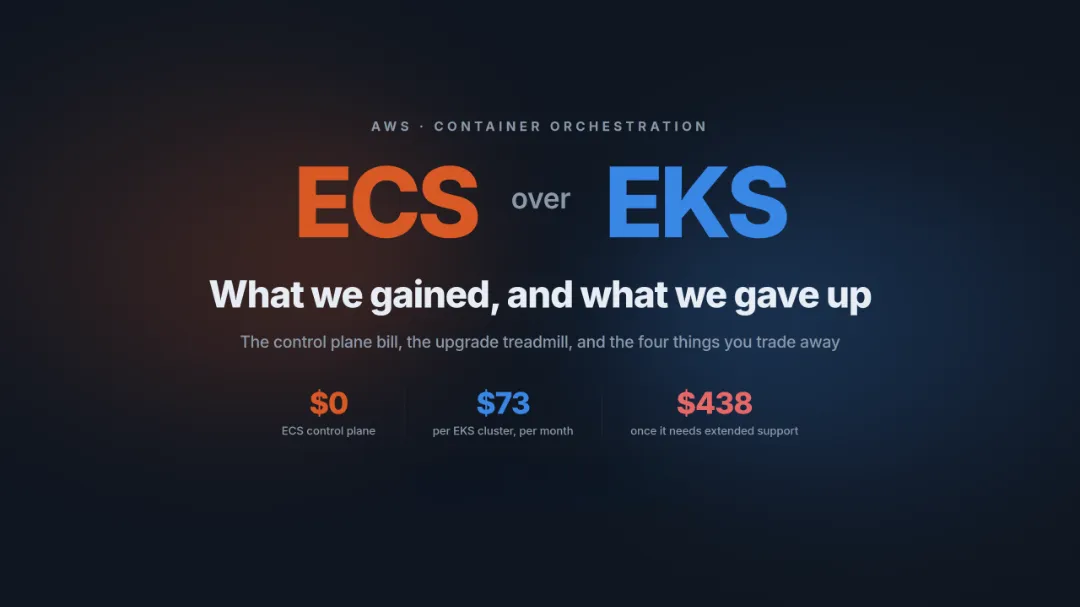
We chose ECS over EKS: what we gained and what we gave up
An honest comparison of ECS vs EKS the costs, tradeoffs, and real-world reasoning behind choosing ECS for a production platform on AWS.
Read More
Upgrading Legacy Systems: From Outdated Technology to Competitive Advantage
Learn how to upgrade legacy systems through application modernization, API integration, cloud migration, security improvements, and incremental system upgrades without disrupting business operations.
Read More
Building Distributed Tracing and Observability with AWS X-Ray
A practical guide to correlating requests across a multi-tier application using correlation IDs, AWS X-Ray segments, and structured logging for faster incident debugging.
Read More