
Common Amazon EventBridge Pitfalls in Production (and How to Avoid Them)

Got a project?
Let's discuss your project
Introduction
Amazon EventBridge simplifies the implementation of event-driven architectures. Publish an event, configure a rule, attach a target-and the system appears to work seamlessly.
However, real-world production environments expose challenges that tutorials and demos rarely cover. When EventBridge is used to decouple services and orchestrate asynchronous workflows, subtle design mistakes can lead to bugs, delivery failures, and operational complexity.
This post outlines the most common pitfalls observed in production environments using Amazon EventBridge and provides strategies to avoid them.
1. Treating Events Like Synchronous Requests
The Pitfalls
Events are often treated like REST calls, assuming:
- Immediate processing of events
- Guaranteed execution order
- Downstream services completing side effects before the next step
Why This Fails
EventBridge is asynchronous by design:
- Event delivery may be delayed
- Processing order is not guaranteed
- Consumers can fail and retry independently
This behavior can result in race conditions and inconsistent system state.
How to Avoid It
- Treat events as notifications, not commands
- Design services to operate independently
- Expect eventual consistency rather than immediate results
- Use synchronous APIs when strict ordering or instant feedback is required
2. Poor Event Naming and Payload Design
The Pitfall
Event names and payloads are often ambiguous or flexible:
- Generic names such as userEvent or orderUpdate
- Payloads evolving over time without versioning
- Multiple consumers interpreting the same event differently
Why This Is Dangerous
Events act as long-term contracts. Poor design leads to:
- Silent breaking changes affecting multiple consumers
- Complex debugging when consumers behave unexpectedly
- Hesitation to evolve system logic due to fear of regressions
How to Avoid It
- Use explicit, past-tense event names (e.g., UserRegistered, OrderPaymentFailed)
- Keep payloads minimal and well-defined
- Introduce versioned schemas (v1, v2) for backward compatibility
Treat event contracts with the same discipline as public APIs
3. Assuming Events Never Fail
The Pitfall
Event delivery is often assumed to be reliable without monitoring:
Let's Build Something Great Together
Ready to transform your idea into a powerful software solution? Talk to our experts and get a free consultation.
Contact Us
- No Dead Letter Queues (DLQs)
- No retry strategy
- No alerts for failed invocations
Production Reality
Failures can occur due to:
- Permission misconfigurations
- Downstream service errors
- Temporary infrastructure issues
These failures may go unnoticed, resulting in missing functionality.
How to Avoid It
- Configure retries with exponential backoff for transient failures
- Attach Dead Letter Queues (DLQs) to all critical rules
- Enable CloudWatch alarms to detect failed deliveries immediately
Failure handling must be built-in from the start.
4. Failing to Design Idempotent Consumers
The Pitfall
Event consumers may assume events are processed exactly once.
Why This Fails
EventBridge guarantees at-least-once delivery. Retries and transient failures can result in duplicate events.
Observed Impacts
- Duplicate emails or notifications
- Repeated database writes
- Multiple calls to external APIs
- Inconsistent application state
How to Avoid It
- Ensure all consumers are idempotent by design
- Use eventId or domain identifiers to detect duplicates
- Persist processed event IDs when side effects are not naturally idempotent
- Design handlers so repeated execution produces the same outcome
5. Ignoring API Destination Constraints
The Pitfall
API Destinations may be treated like normal backend services, without considering limitations.
Production Reality
- EventBridge enforces a ~5-second maximum timeout
- Slow or blocking processing causes retries and DLQ accumulation
- Partial workflow completion occurs without immediate visibility
How to Avoid It
- Keep API Destination requests lightweight
- Offload heavy processing to queues or background workers
- Ensure fast acknowledgment to avoid retries
6. Overlooking Connection Authorization
The Pitfall
Connections to external APIs or services are often assumed to be permanent and stable.
Production Reality
Failures occur due to:
- OAuth token expiration
- Secret rotation
- Permission or configuration changes
These issues can cause silent delivery failures if monitoring is missing.
How to Avoid It
- Monitor connection health
- Include authorization checks in operational checklists
- Add alarms for failed invocations due to authentication errors
7. Overusing EventBridge for All Flows
The Pitfall
Using EventBridge for every workflow, including simple CRUD operations or synchronous flows, introduces unnecessary complexity.
Observed Impacts
- Debugging became slower
- Simple workflows became harder to trace
- System complexity increased without adding value
How to Avoid It
Use EventBridge only when:
- Services require loose coupling
- Processing can be asynchronous
- One event must trigger multiple independent consumers
Use synchronous APIs when:
- Immediate responses are required
- Flows are simple and request–response in nature
- Predictable execution and easy debugging are priorities
8. Poor Observability and Traceability
The Pitfall
Without proper observability:
- Logs are scattered across services
- No correlation identifiers exist
- Event lifecycles cannot be traced end-to-end
Production Reality
Failure investigation becomes time-consuming and unreliable.
How to Avoid It
- Propagate correlation IDs through all events
- Implement structured, centralized logging
- Track success and failure metrics per rule
- Ensure end-to-end traceability for all critical workflows
Key Takeaways
Production experience with Amazon EventBridge demonstrates:
- Event-driven systems require different design assumptions
- Events are durable contracts, and payloads must be stable
- Idempotency is mandatory for all consumers
- Platform limitations (timeouts, authorization, retries) must be accounted for
- Observability is essential for operational confidence
EventBridge is a powerful tool, but success in production depends on discipline, monitoring, and architectural design, not just configuration
Recommendations for Production Use
- Define event contracts before writing code
- Enforce idempotency across all consumers
- Plan for DLQs and monitoring from day one
- Respect API Destination constraints
- Monitor connection authorization continuously
- Apply EventBridge selectively for asynchronous, fan-out, or decoupled workflows
- Invest in observability and structured logging early
Following these guidelines reduces operational risk, improves reliability, and makes event-driven architectures easier to manage.
AI Writes the Code • Stop Blindly Shipping It Without Reviewing the Engineering
A practical perspective on AI-generated code, scalability, maintainability, and engineering judgment and why engineering review still owns the final decision.
Read More
Migrating Databases with AWS DMS With Nearly Zero Downtime
Learn how to migrate databases using AWS DMS with nearly zero downtime using Full Load, CDC, validation, monitoring, and controlled cutover.
Read More
How to Add LiveKit Video Calling to a Next.js App
Add embedded video & audio calling to Next.js with LiveKit Cloud. Compared vs Twilio, Daily, Agora, Zoom — plus token auth, guests & recording.
Read More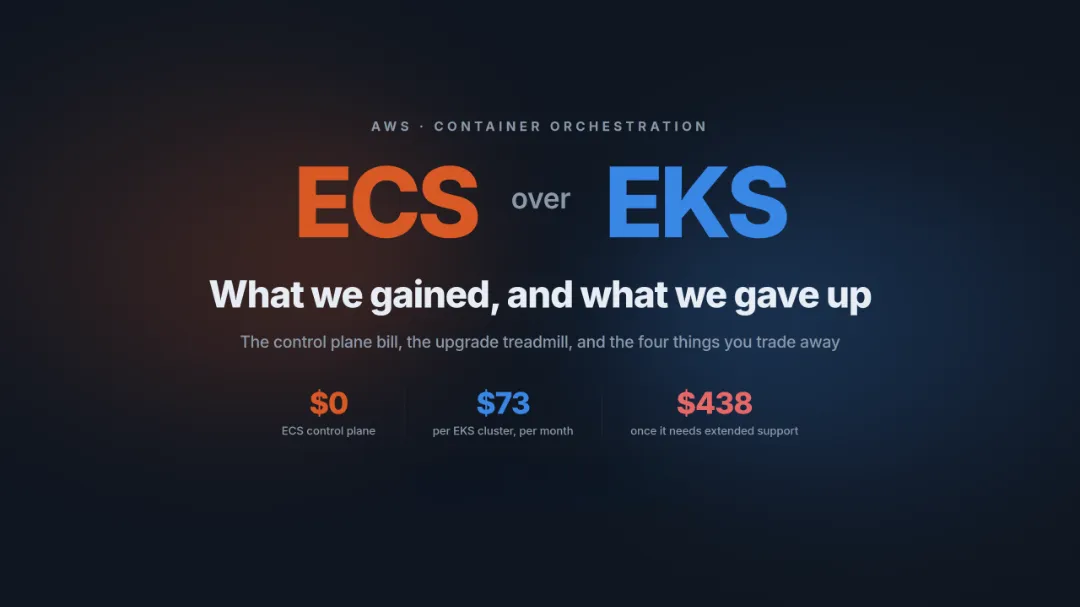
We chose ECS over EKS: what we gained and what we gave up
An honest comparison of ECS vs EKS the costs, tradeoffs, and real-world reasoning behind choosing ECS for a production platform on AWS.
Read More
Upgrading Legacy Systems: From Outdated Technology to Competitive Advantage
Learn how to upgrade legacy systems through application modernization, API integration, cloud migration, security improvements, and incremental system upgrades without disrupting business operations.
Read More
Building Distributed Tracing and Observability with AWS X-Ray
A practical guide to correlating requests across a multi-tier application using correlation IDs, AWS X-Ray segments, and structured logging for faster incident debugging.
Read More
Designing Before and After AI: What Really Changed
A look at how AI has transformed UI/UX design from manual wireframes and slow research to AI-assisted prototyping, design-to-code, and personalization at scale.
Read More
Beyond Prompting: Managing Context and Tokens in AI Coding Tools
Ever wondered why your AI coding agent starts losing context or hits a hard limit mid-task? The answer lies in tokens and the context window. Good AI coding is not about giving the model the most information. It is about giving it the right information at the right time.
Read More
What Is llms.txt? How It Helps Google, AI Search, and Agentic Browsing Find Your Website
Learn what llms.txt is, how it differs from sitemap.xml and robots.txt, and how it can help your site get found by Google, AI search tools, and AI agents.
Read More